Everyone's found a way past the wine list. None of it knows you.
The intimidation is real, and people are reaching for whatever gets them through it. A crowd-rating app. A chatbot at the table. Here's why neither was built for your taste, and what finally is.
Fifty bottles, and no one who knows you.
A great sommelier is a gift, and if your table has one, lean in. Unfortunately, most tables don't. So you ask the server working ten other tables what's good, and you get pointed at the second-priciest red – the safe upsell, not the bottle you'd have loved. The list is long, the night is moving, and you're on your own.
A score from a thousand strangers isn't your taste.
So you pull out the popular wine app. You know the one. It hands you a number, a 3.9 averaged from thousands of strangers. That's what a crowd liked, on average. It can't tell you what you'll like, because it has never tasted a thing the way you do. Popular and yours are rarely the same bottle.
US wine drinkers have already used AI to choose a bottle they bought. Among drinkers 21 to 39, it's more than half.
Wine Opinions · January 2026 survey of 1,351 US wine drinkers →A chatbot meets you cold, every time.
So you do the obvious thing and open a chatbot: snap the list, ask what to order. The people who cover wine have watched it happen, and keep noticing the same catch: it doesn't know you.
A.I. Is Coming for the Sommeliers
A PwC engineer tells Asimov that ordering wine out feels like “a quiz you didn't prepare for,” so he shoots the list into ChatGPT. A chatbot can name a bottle, Asimov notes, but it can't read your table or your taste.
Read the piece →What AI Can, and Can't, Do for Your Wine Education
Wine has been sold to “connoisseurs” for decades, and the intimidation is real enough that US wine volume is down 27% since 2019. What people say they want from AI is a patient, judgment-free guide, which is exactly the gap at the table.
Read the piece →They're right that it isn't enough. But the fix was never to go back to guessing. It's a tool that remembers what you love, and picks from there.
Not the crowd's. Not a blank slate. Yours.
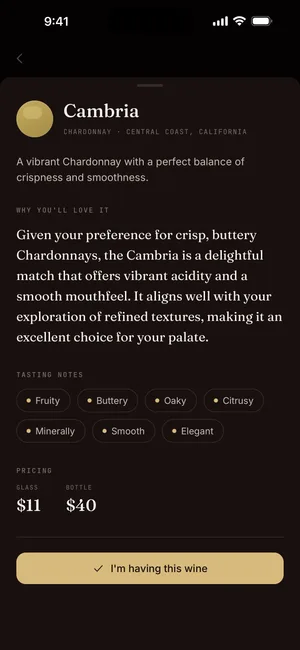
That's sommelai. It reads your palate up front, then sharpens that read with every bottle you rate, so it remembers what you actually reach for. Point it at the list and it picks from your taste: not a crowd's average, not a chatbot's blank slate. Not a database. Not a chatbot. A palate that's yours, carried to every table.
Free. No subscription, nothing to unlock.
Writing about how people order wine? We're glad to talk.
[email protected]